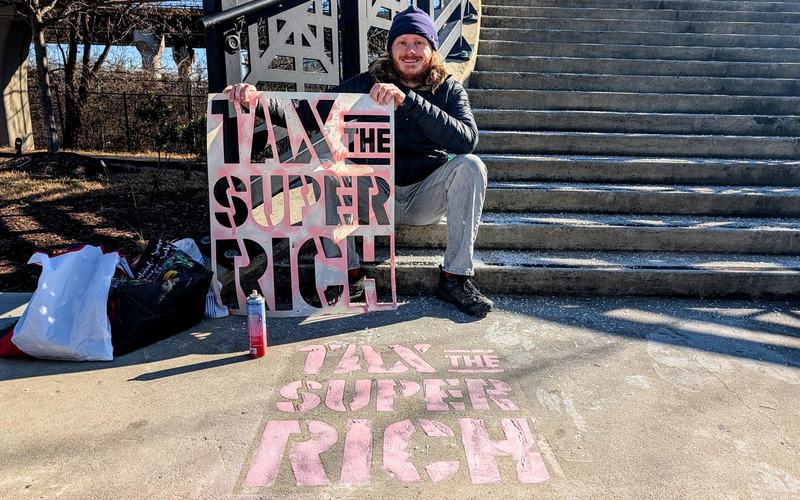
Extreme wealth concentration is not inevitable. Here are four practical ways to reduce it.
Extreme wealth concentration can feel too entrenched to change. In the United States, fortunes at the top have grown dramatically while millions of people struggle to afford housing, food, healthcare, and other essentials.
This situation is not inevitable. Extreme wealth concentration is the result of policy choices, including decisions about taxation, wages, corporate regulation, and who gets a voice in our democracy. That also means different choices can move us toward an economy that works for everyone.
Oxfam, the global organization that fights inequality to end poverty and injustice, offers four connected solutions to reduce extreme wealth: unrig the tax code, reimagine the social safety net, support workers’ rights, and rebalance power. No single reform will solve inequality on its own. Together, however, these approaches offer a realistic path forward.
1. Unrig the tax code, starting with extreme wealth
One of the most direct ways to reduce extreme wealth concentration — and the outsized political power that accompanies it—is to tax wealth more fairly.
Most people pay taxes as they earn wages. Billionaires, however, hold much of their wealth in assets such as stocks. Those assets can increase enormously in value without being sold, and the gains generally are not taxed until a sale occurs. This can allow an ultra-wealthy person to build a rapidly growing fortune while deferring taxes on much of that growth.
Oxfam supports taxing extreme wealth as an efficient way to curb the power of the ultra-rich, reduce wealth concentration, and raise revenue for public investments. There are two main approaches to taxing extreme wealth.
- Tax on increases in wealth: Under this approach, the wealthiest taxpayers would pay tax on the annual growth in the value of assets such as stocks, even if they had not yet sold them. The proposed Billionaires Income Tax Act, for example, would amend tax rules so that affected billionaires pay taxes annually and cannot indefinitely defer taxation.
- Tax on net worth: Such a tax would apply an annual tax to a person’s total fortune above a very high threshold. In effect, it would operate somewhat like a property tax, but across the full range of assets held by the ultrawealthy. Proposals already introduced in Congress show how this could work.
- The Make Billionaires Pay Their Fair Share Act would impose a 5% annual tax on the net value of assets for those whose wealth exceeds $1 billion.
- The Ultra-Millionaire Tax Act would apply a 2% tax to net worth above $50 million, with a higher rate on wealth above $1 billion.
- The Make Billionaires Pay Their Fair Share Act would impose a 5% annual tax on the net value of assets for those whose wealth exceeds $1 billion.
These are legislative proposals, not current law, but they demonstrate that wealth taxation is a concrete policy option rather than an abstract idea. Either proposal would raise trillions of dollars in revenue over the next decade, which could be used for social programs and efforts to fight poverty.
Beyond taxing extreme wealth directly, a fairer tax code should also increase taxes on the highest incomes and large, profitable corporations, close loopholes, address tax dodging, and tax income from wealth more like income from work.
States do not have to wait for federal action. In 2026, Washington state, Maine, Hawaii, and Rhode Island approved higher income taxes on people with very high incomes. Washington state’s millionaires’ tax alone is projected to raise $3 billion in 2029 for education, childcare, and tax credits for low- and moderate-income families. These measures show that governments can make tax systems fairer while raising revenue for widely shared priorities.
2. Reimagine the social safety net
Taxing extreme wealth is not simply about collecting revenue. It is about what society can accomplish with shared resources.
In the U.S., a stronger social safety net could help ensure that everyone has access to fundamental needs such as healthcare, food, housing, education, transportation, and childcare.
Current U.S. policy, however, represents the inversion of a fair economy. Rather than taxing the rich to fund needed public services, the One Big Beautiful Bill Act (OBBBA)— signed by President Trump in July 2025 —puts money in their pockets. It has created the single largest upward transfer of wealth in decades. The law slashes taxes for corporations and the ultra-rich, while cutting over $1 trillion from Medicaid and the Supplemental Nutrition Assistance Program (SNAP), depriving millions of people access to healthcare and food.
The first step in strengthening the safety net is repealing the OBBBA’s cuts to food and health programs. Beyond this, the U.S. should invest in proven programs that reduce poverty and inequality, including an expanded child tax credit, guaranteed income, and high-quality, universal public services. The goal should be more than helping people endure poverty. It should prevent poverty and give everyone the opportunity to thrive.
3. Support workers’ rights
Reducing inequality also requires ensuring that working people receive a fair share of the value they create.
That means expanding and protecting the right to form unions and bargain collectively, raising the minimum wage, eliminating subminimum wages and exclusions from labor protections, guaranteeing paid family and medical leave, and enforcing equal-pay and workplace-safety laws.
4. Rebalance power
Wealth is not only about money. It is also about power.
When a small number of individuals and corporations control an enormous share of the country’s resources, they can gain disproportionate influence over markets, workplaces, public policy, and political debate. Large corporations can use their power to influence prices and wages, and can spend heavily to shape elections and policy decisions.
Rebalancing power means supporting workers, families, and community organizations that are already developing solutions to the problems they face. It also means confronting monopolies and harmful corporate concentration, protecting voting rights, reforming campaign finance rules, and ensuring that people have a meaningful voice in the decisions that affect their lives.
If economic rules continue to be shaped by those who benefit from the status quo, even well-designed reforms will be difficult to enact or sustain.
Extreme wealth concentration is a choice, and so are the solutions
There is no single switch that will end extreme wealth concentration. But there is a realistic agenda that includes taxing extreme fortunes, investing in people and public services, strengthening workers’ power, and confronting corporate concentration.
The obstacle is not a lack of ideas. It is whether we can build the political will to put them into practice. Extreme inequality was created through policy choices. With sustained public pressure and collective action, those choices can be changed.