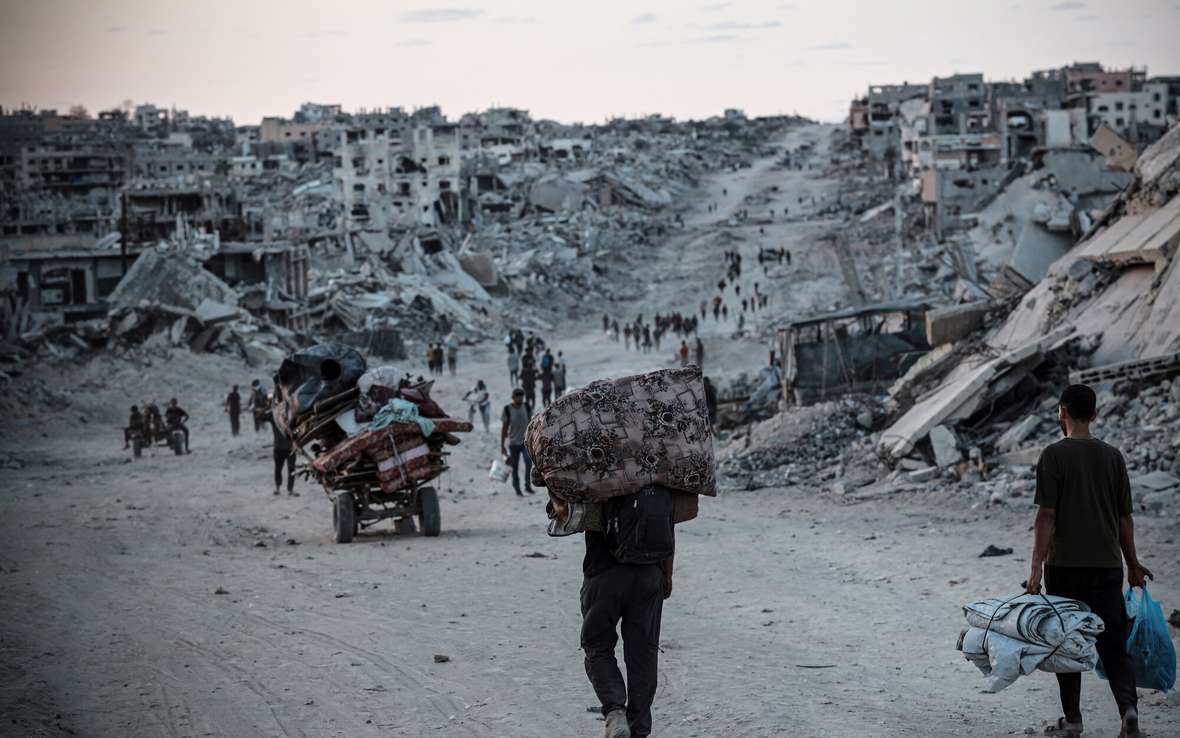
The situation in Gaza is fast-moving and at times confusing. Here's what's happening, and what you can do to help.
Key Facts
- The humanitarian situation in Gaza continues to be dire, despite a ceasefire announced in October of 2025. Most of the 2.1 million population lacks adequate food, shelter, clean water, and decent sanitation, according to the UN.
- The Israeli government used hunger as a weapon in Gaza. bringing the territory into a man-made famine in summer of 2025, after imposing severe restrictions on the import of food and other forms of aid for most of the war. Since the ceasefire, an uneven increase in the entry of food has improved the situation somewhat, but gains remain fragile and most of the population lacks proper nutrition and remains reliant on aid.
- Since the beginning of the war in early October 2023, Oxfam has supported 20 local partners providing food, clean water, sanitation systems, and hygiene support. Together we have reached 1.53 million people with humanitarian aid.
The latest ceasefire deal agreed to in October 2025 led to a temporary increase in the volume of commercial goods and humanitarian aid entering Gaza, but deliveries remain insufficient to meet the scale of needs across the territory. Much of the commercially available food in Gaza has been unaffordable for most of the population, and most families still lack reliable access to nutritious food.
The needs remain urgent. People in Gaza haven’t had enough food for years and remain in critical need of sustained, transparent, predictable, humanitarian aid. Most of the population also still lacks access to dignified and appropriate shelter, water, sanitation, and health care.
Instead of fully implementing the peace agreement, the government of Israel has continued to severely limit humanitarian aid and maintained its arbitrary, opaque, and politicized system for humanitarian access in Gaza. Despite these challenges, Oxfam remains operational in Gaza and the West Bank via its registration with the Palestinian Authority and continues to pursue its mission in close collaboration with partner organizations in Gaza.
How much food is getting into Gaza?
Commercial and humanitarian supplies are entering Gaza through a limited number of channels and organizations, which is contributing to measured improvements in some communities. However, the volume is still far below what is acceptable to meet critical needs, and Israeli authorities continue to limit humanitarian supplies. This is keeping families in a state of perpetual crisis.
While some types of food and other goods have become more available in local markets, they remain largely unaffordable for many Palestinians, 80% of whom are unemployed.
Prior to the start of the war, 45% of all food in Gaza was produced locally, as were 100% of its vegetables. The people in Gaza relied on about 500 truckloads a day for aid and commercial goods. Over the past two+ years, only a fraction of food that used to be delivered daily has been allowed through.
The war in Gaza has damaged 70% of Gaza’s cropland, and nearly all of what remains is inaccessible due to Israeli restrictions. Farms, orchards, and greenhouses have been destroyed along with nearly the entire fishing fleet.
While access to food has increased unevenly since the ceasefire, these gains remain highly fragile. The latest global hunger report showed that 1.4 million people in Gaza are expected to face crisis levels of acute food insecurity through December 2026.
Water crisis in Gaza
Under Israeli blockade for the last 17 years—and even tougher restrictions following the war in October 2023--Gaza already had limited ability to manage its essential resources, particularly water.
During the conflict, more than 2 million people (nearly the entire population of Gaza) were struggling to survive without access to clean water, which is a fundamental human right.
- Over the course of the war, Israeli military operations and restrictions severely reduced the amount of water available in Gaza, at some points by 94%, leaving than five liters a day per person—equal to less than a single toilet flush.
- The destruction (and denial) of water and electricity infrastructure—as well as restrictions on the entry of spare parts and fuel—saw water production drop precipitously in Gaza; at some points by 84%.
- Israeli operations have destroyed 70% of all sewage pumps and 100% of all wastewater treatment plants.
As of August 2026, more than 60% of households still cannot access the minimum humanitarian standard of six liters of water per person per day, and no households can use a safely managed wastewater treatment system.
Oxfam's teams have reached more than 800,000 people with water, sanitation, and hygiene support since Israel’s military campaign on Gaza began. Reconstruction of water and sanitation systems is a high priority that will help Gaza avoid outbreaks of water-borne diseases and ensure that whatever food people can eat can be digested safely.
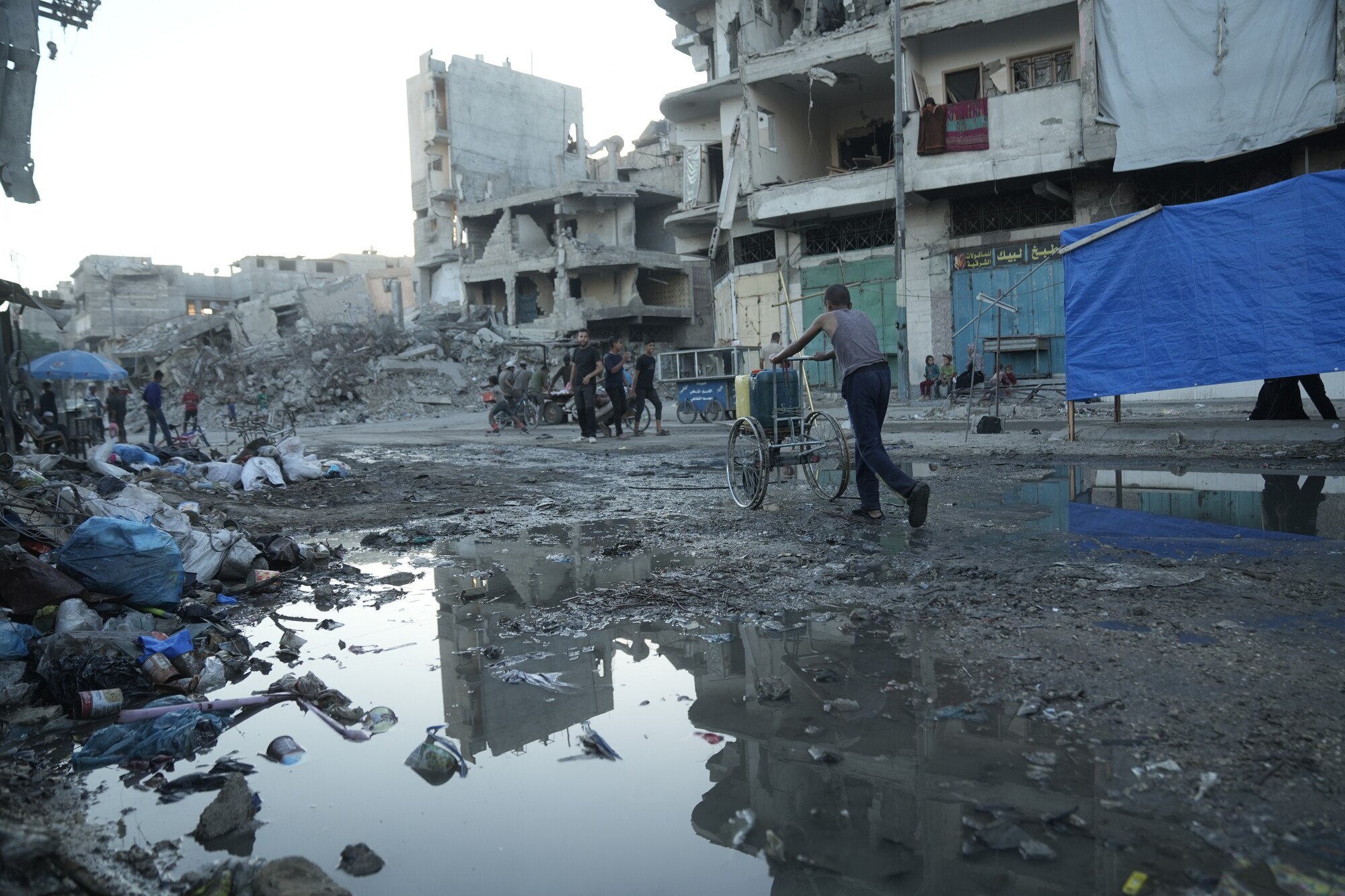
Following the announcement of the ceasefire in October 2025, Oxfam is working with partner organizations in Gaza that are providing clean water for displaced people, repairing water and sanitation systems (including building hundreds of latrines in southern Gaza), and helping people access crucial hygiene items like soap and menstrual products.
How did we get to this?
The Israeli military has occupied Palestinian territory, which includes Gaza, the West Bank, and East Jerusalem, for 59 years. Israel has also imposed a blockade on Gaza since 2007, which has devastated Gaza's economy, left most people unable to leave, restricted them from essential services such as health care, and cut Palestinians off from each other.
On October 7, 2023, Hamas and other armed Palestinian groups carried out appalling, brutal attacks in Israel, targeting and killing hundreds of civilians. A total of 1,139 people were killed, and 240 people were taken hostage.
Immediately following the attacks on October 7, Israeli Defense Minister Yoav Gallant ordered a “complete siege” on Gaza, at the onset of a military campaign that has involved widespread airstrikes and ground operations in Gaza, resulting in catastrophic loss of life and injuries to Palestinian civilians.
Though the complete siege imposed at the start of the campaign was subsequently loosened somewhat, the Israeli government has tightly controlled and constrained humanitarian operations throughout the course of the war, systematically throttling the volume, range, and operational space of humanitarian delivery.
Early in the conflict, the government of Israel ordered the evacuation of more than a million people from northern Gaza. The directive gave them just hours to pack up and leave their homes, which meant their food supplies and access to agricultural land were lost overnight. Similar orders were given dozens of times over the next two years, confining Palestinians into ever smaller enclaves in Gaza.
After 15 months, a temporary ceasefire was announced on January 15, 2025; it held for two months before collapsing. People in Gaza again faced overwhelming levels of humanitarian crisis across all sectors following the Israeli government’s re-imposition of a full blockade and resumption of intensive air and artillery strikes and military campaign in March.
The famine classification by the Integrated Food Security Phase Classification, issued in August 2025, confirmed what Oxfam staff and the entire humanitarian community in Gaza had been warning for months: The government of Israel’s continued campaign of bombing and blocking aid created conditions for the starvation of Palestinian families in Gaza.
Following the announcement of the peace plan in October 2025, more aid has been allowed into Gaza, though it has been limited to a select number of commercial and humanitarian actors, and has not been anywhere near enough to address the humanitarian crisis. The government of Israel later announced it would not allow 37 major international aid organizations to renew their registration to work in Gaza, after introducing a new arbitrary and politicized registration process. This is now another layer of the system that continues to limit the quantity and quality of aid allowed into Gaza.
Renewed conflict across the Middle East breaking out in March 2026 is putting added economic pressure on Gaza. Movement restrictions and persistent insecurity are deepening an already severe humanitarian crisis. The flow of aid and commercial goods into Gaza remains constrained, and while some fuel has entered the Gaza Strip, supplies remain critically low, affecting humanitarian operations and daily life.
Over nearly three years of conflict in Gaza, more than 73,000 Palestinians (the majority believed to be non-combatants) have been killed by Israel's destructive military campaign. This includes at least 1,200 Palestinians who have died since the announcement of the peace plan and ceasefire in October of 2025.
What is Oxfam doing in Gaza?
In collaboration with 20 partner organizations in Gaza, Oxfam has reached more than 1.53 million people with lifesaving assistance since October 2023.
Oxfam continues to source aid and materials within Gaza in order to assist partner organizations, people displaced by the conflict, and those on the move who are choosing to return to their homes. We are focusing on a range of emergency interventions including:
- Providing clean water for displaced people
- Facilitating access to food supplies
- Creating access to hygiene items, including menstrual products
- Rehabilitating water and sanitation systems and wells
- Renovating solid waste management infrastructure
- Offering training and inputs for home gardens to help people grow vegetables, and irrigation equipment and other support for farmers
- Increasing support for women’s rights organizations helping survivors of gender-based violence and providing other essential services for women and girls affected by the conflict.
Oxfam and partners have worked under unimaginable conditions to deliver lifesaving aid in Gaza. Our teams have reached more than 800,000 people with WASH support since the war began and have continued to provide protection services to the most vulnerable, especially women and children.
Oxfam partners include the Palestinian Medical Relief Society, Juzoor for Health and Social Development, the Economic and Social Development Center of Palestine, the Palestinian Agriculture and Relief Commission, and the Palestinian Development Association. They are providing psychological first-aid training and counseling to youth, as well as supplies like food parcels, clothes, blankets, menstrual products, and soap. This assistance is reaching those living in makeshift shelters in the northern and southern region of the Gaza Strip.
Oxfam has worked in the Occupied Palestinian Territory and Israel since the 1950s. We have supported communities in Gaza, East Jerusalem, and the West Bank to tackle the root causes of conflict, build resilience to sudden shocks, and protect their rights.

Is UNRWA still operating in Gaza?
Yes. The UN Relief and Works Agency has 11,000 personnel providing aid and services to people in the Gaza Strip, according to a recent statement. This is despite policies blocking UNRWA from bringing people and aid into Gaza and obstructing its basic operations.
What needs to happen now?
- U.S citizens need to advocate for a full ceasefire, urgent humanitarian aid, and a just peace for Gaza.
- Israel must facilitate the registration of established humanitarian non-governmental organizations to allow them to continue their work
- Israel must allow full and unrestricted humanitarian access to Gaza, fully opening all crossings and ending arbitrary restrictions on freedom of movement and access.
- Hamas and Israel must abide by the parameters of the ceasefire and peace agreement
The need for peace
The peace agreement and ceasefire must set the conditions now for creating a lasting and just peace for all Palestinians and Israelis. To break the cycle of violence, the international community must tackle the root causes of injustice and violence that are being perpetrated under the Israeli occupation and blockade of Gaza—before and after the October 7 attacks.
Military force cannot resolve this decades-long conflict. The continuing violence is not bringing us any closer to the peace that both Palestinians and Israelis need and deserve.
The United States, UN member states, and countries named as members of the Board of Peace must act now to correct past failures and do all in their power to push for the ceasefire to be fully implemented with increased access and improved conditions for a surge of aid and other vital goods. The ceasefire must be the first step towards a path to sustainable peace and security for all Palestinians and Israelis. We cannot have this fragile progress undermined by continued impunity and policies that do not respect the lives, dignity and future of Israelis and Palestinians equally.
The future of Gaza
Research commissioned by Oxfam and carried out by the Palestinian Trade Center and the Palestine Economic Policy Research Institute has found that the war starting in 2023 in Gaza has been “one of the most punitive and destructive military assaults in living memory.” Their findings indicate widespread damage to not only the physical buildings and institutions of the Gaza Strip, but also the social fabric. Their report, “Building Gaza Anew” offers practical steps for implementing a just, Palestinian-led recovery, protecting the rights and dignity of civilians affected by conflict, and ensuring meaningful participation of credible Palestinian institutions and civil society organizations.
Oxfam America is calling on the U.S. government to
- Protect civilians and ensure humanitarian access: Use U.S. leverage to secure unrestricted humanitarian access, protect civilians, prevent forced displacement, and uphold international law.
- Support accountable, community-led recovery: Back transparent reconstruction efforts led by Palestinians and supported by trusted humanitarian partners, and reject aid models that politicize assistance or put Palestinians at risk.
- Advance Palestinian rights, freedom, self-determination: Put Palestinian human rights at the center of reconstruction and recognize the State of Palestine.
Find out more
- For the most reliable updates on the situation, visit the U.N. OCHA website.
- Donate to our Gaza Emergency Appeal.
- How to help Gaza