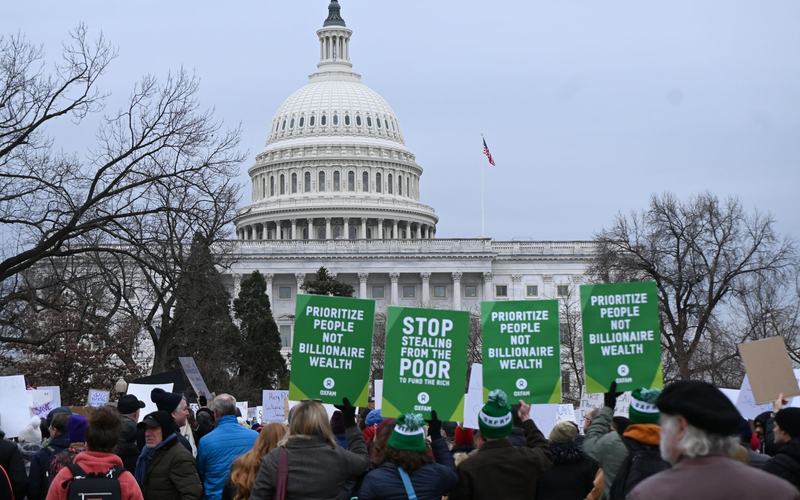
Don’t expect proposals to tax billionaires to go away anytime soon—democracy is on the line, says Oxfam America’s Associate Director for Economic Justice Rebecca Riddell.

The 2026 Billionaire Tax Act, a California ballot initiative aimed at raising revenue for critical public services by curbing the excessive wealth of billionaires in that state, has been defeated at the polls.
While more than 5 million Californians voted for the Act, also known as Proposition 40, the effort faced significant, deep-pocketed headwinds. A well-funded opposition—fueled by some of the wealthiest billionaires in the world—raised more than a gob smacking $330 million to oppose the effort.
That’s unsurprising given California has some of the highest levels of wealth inequality in the country. The billionaires opposed to the measure spent like oligarchy was on the line.
The voters, labor groups, activists, economists, and civil society organizations backing Prop 40, including Oxfam, got their attention. And now the momentum for change will continue to grow.
What taxing billionaire wealth could have meant for families
Prop 40 was a big deal—the first initiative put before U.S. voters to tax billionaire wealth, not income. The initiative was opposed by a billionaire-funded political committee and several prominent members of California’s political establishment, including California Governor Gavin Newsom. Estimates suggest this one-time 5% tax on billionaire wealth could have raised more than $100 billion.
That money could have mitigated huge federal cuts to health care, education, and food assistance coming early next year. In California alone, more than 1.3 million people stand to lose their health coverage under Medicaid, and more than 3 million households could face reductions in food assistance.
These cuts were part of President Trump’s One Big Beautiful Bill Act, signed into law in July 2025. A health care union introduced Prop 40 specifically to help shore up state health care systems following federal cuts.
Why Prop 40 was an important step for tax justice—even if it failed
Prop 40’s defeat shows that while public support for fairer tax policy is strong, so too is anti-tax opposition. That’s especially the case from self-interested billionaires who stand to have to share some of their wealth. We should expect that to continue, especially given the 10 richest Californians are now worth a collective $1.199 trillion—up $244 billion since September 2025.
But we should remain optimistic for several reasons. It’s striking that there was so much support for a relatively novel wealth tax proposal. Prop 40’s authors needed 874,641 signatures for the initiative to appear on the ballot, and they received 1.6 million. More than 5 million Californians then voted for Prop 40. This signals a high level of demand for policies that will help working-class people and change a system that seems rigged for the ultra-wealthy.
The fight for Prop 40 also generated more awareness of what’s at stake, not just in California but around the country. We have a poorly designed tax code that lets billionaires often pay shockingly low tax rates compared to ordinary people. That is a problem, for our public coffers and for democracy, and people are waking up to that.
Polls show the U.S. public is increasingly alarmed about the relationship between extreme wealth and the outsized political power that accompanies it. We expect to see political leaders step up, heed public demands, and unrig tax policy, so that it helps ordinary families who are stretching every dollar, rather than billionaires and trillionaires.
Lastly, Prop 40 exposed the moneyed networks opposing these kinds of tax reforms and the false narratives they rely on. Despite what billionaire anti-tax activists would have you believe, the super-rich are not impossible to tax. When the Biden administration increased the IRS’s budget and focused on enforcing the tax rules that apply to the wealthiest people, it paid huge dividends.
Similarly, taxing billionaire wealth does not lead to a massive exodus that costs the state money. Even if a quarter of all billionaires had left California because of Prop 40, they pay such a small portion of their wealth in taxes that it would take a century before their lost income taxes exceed the revenues Prop 40’s one-time wealth tax would have provided.
What this outcome means for the larger fight to tax wealth
It might not fit on a bumper sticker, but tax policy is one of the most powerful tools we have for delivering the kind of society we want to see. Oxfam America endorsed Prop 40 because we are serious about exiting this second Gilded Age. Extraordinary levels of wealth concentration require equally extraordinary solutions, and the 2026 Billionaire Tax Act was a meaningful response to the inequality crisis we’re all facing.
But California is far from alone in seeking to tackle this crisis. There are other legislative proposals currently before the U.S. Congress to curb the power of the ultra-rich, reduce wealth concentration, and raise revenue for public services. These include the Make Billionaires Pay Their Fair Share Act, which would impose a 5% annual tax on the net value of assets for those whose wealth exceeds $1 billion. And the Ultra-Millionaire Tax Act, which would apply a 2% tax to net worth above $50 million, with a higher rate on wealth above $1 billion.
Over the last year, several states have also approved higher income taxes on ultra-wealthy people, including Washington state, Maine, Hawaii, and Rhode Island. While ultimately federal policymakers should pass fairer tax policy instead of enriching the very wealthiest, for now, states are leading the way. Oxfam is going to continue to work with our supporters to create a more equal world for all.