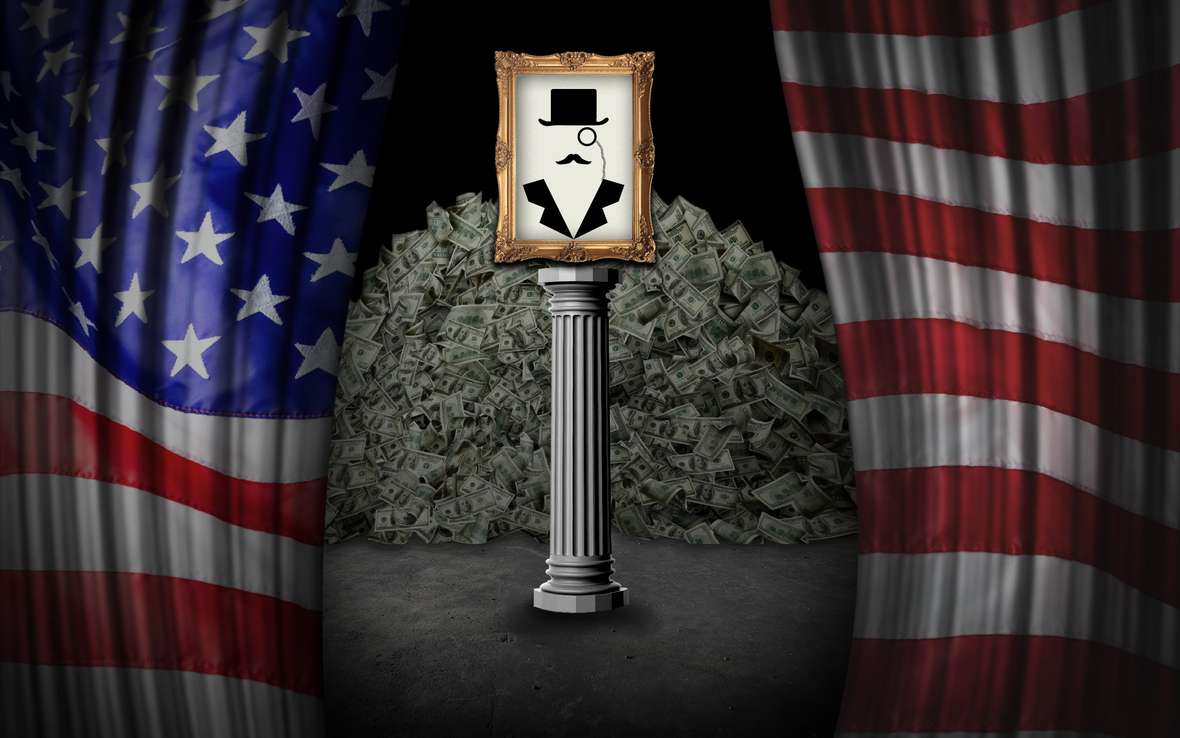
By punishing the working class, the Trump administration reveals its true keepers and beneficiaries—the billionaire class, says Oxfam America’s Economic Justice Director Nabil Ahmed.
We need a rethink on U.S. foreign economic power and policy.
The truth is we needed one long before the unlawful war against Iran. Before this new and unfathomable human toll, before the energy and humanitarian crises it's creating.
But it does mean the stakes are now more urgent and more honest. We must double down on what remains at the heart of this rethink. The kind of reimagination that will be central to the U.S.’ role in addressing inequality– at home and internationally–in the 21st century.
America First is not for the working class
First, on America First.
The international economic policies of this Trump administration are unmistakably inequality-exacerbating. The list is long—from reckless tariffs to harmful aid cuts, from lethal sanctions to coercive tax breaks for Big Tech abroad.
Gas prices are up at the pump. Oil companies’ profits are soaring. America First drives inequality in the world, but so too it drives inequality here in the U.S.
The frames widely used to assess America First discourse here fail to get it. America First is often taken at face value, instead of being called out for being part of the oligarch-friendly agenda that it is—one that punishes the working class, even as it acts in their name.
We should be asking: Why is that? And what frames are needed instead?
America First is not an entirely new phenomenon
Second, on America—and what's often seen as a coercive, even as some would say, imperial-like power.
What does this moment reveal not about the last 16 months of a second Trump administration, but about many years prior, across administrations and across parties?
And let's try hard to answer this not so much from the perspective of elite discourse, but actual ordinary folks around the world and here in the U.S.
What's new and what's not? Often the answer we hear is that it’s not simply new—it’s worse, but not without precedent.
Where do we go after America First?
And third, in a world that is more unequal within countries, but also more multipolar—in which power has risen and asserts itself in the East and the South—what will the U.S.' offer be to that world and as part of that world? How can we create a true economic policy for the global working class?
We have to ask ourselves the harder questions now, even if they do not feel easy to achieve tomorrow. What, practically, are the priority policies needed for the future, from tax and intellectual property to trade and the climate transition? How can we advance taxes on billionaires globally—and assert the rights of workers internationally across borders?
At Oxfam we don't come to this because we stay up at night thinking about ‘great power conflict’, as important as that may be to some. We do so because we stay up at night thinking about ending poverty and injustice.
We work in over 75 countries the world over, up close with what ordinary folks are going through. We work here in the United States as well, up close with what folks are going through.
And what's become ever clearer to us is that the story for someone in the working class—be they in Jackson, Mississippi or in Johannesburg, South Africa—it can sound surprisingly familiar.
We think there's a solidarity that's daring to be unearthed. And we hope you join us in this rethink.
This article was derived from a special event entitled, "Beyond America First: U.S. International Economic Policy in a Multipolar World" hosted by Oxfam and Partners in Health during the IMF–World Bank Spring Meetings. Note: The full event (57 minutes) is also available on YouTube at youtube.com/watch?v=sXXMimNKG_8