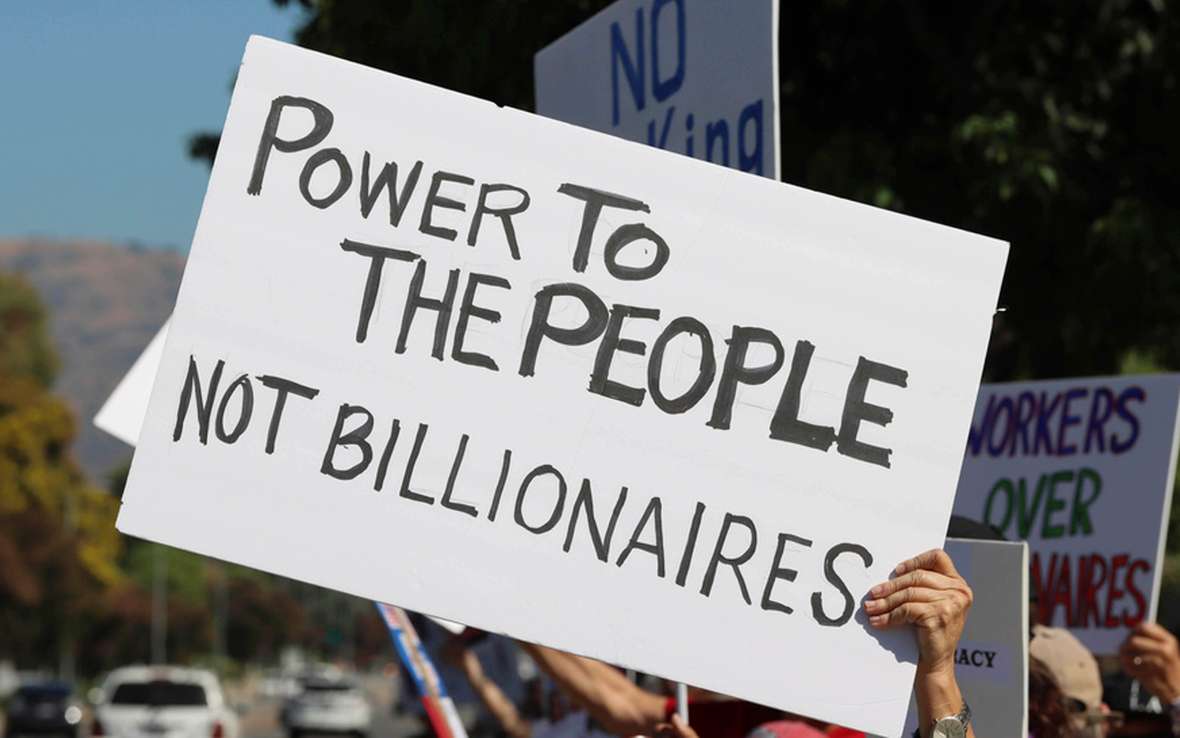
A massive surge in billionaire wealth threatens our everyday lives and economy, from the rights of workers to the stability of the social safety net.
Global inequality trends couldn’t be more alarming. New Oxfam data shows that in 2025, billionaire wealth increased three times faster than the average growth rate for the previous five years, while nearly half the world’s population lives in poverty.
People in the U.S. and around the world are struggling to pay the high costs of food, housing, and other necessities, yet in 2025, the wealth of the world’s billionaires jumped by over 16 percent to a record high of $18.3 trillion... how is this possible?
Our new report, “Resisting the Rule of the Rich,” reveals how the billionaire oligarchy and the corporations they control are using their wealth and influence to stay in power while ordinary people continue to struggle to pay for the basics like food, housing, and medical care.
In short, billionaires are bad for the economy. How bad? Check out these top five ways:
1. Most billionaire wealth is taken, not earned
About 60 percent of billionaire wealth comes from one of three sources: inheritance, cronyism and corruption, or monopoly power. Trillions are being gifted in inheritance in particular, creating a new aristocratic oligarchy that has immense power in our politics and our economy.
Our deeply unequal world has a long history of colonial domination, which has largely benefited the richest people. The poorest, racialized people, as well as women and marginalized groups have and continue to be systematically exploited at huge human cost.
2. Monopoly power is driving wealth inequality and global economic imbalance
We call them monopoly men—billionaires that lead corporations that shape and control markets, set the rules and terms of exchange with other companies and workers, and set higher prices without losing business.
As monopolies have tightened their stranglehold on industries, billionaires have seen their wealth skyrocket to unprecedented levels. The number of billionaires topped 3,000 for the first time in 2025, while the world’s richest man, Elon Musk, became the first person whose net worth surpassed half a trillion dollars.
You don’t have to look far for billionaires who have amassed wealth from huge corporate power:
For example:
- Jeff Bezos built the Amazon "empire." Amazon accounts for 70 percent or more of online purchases in Germany, France, the UK and Spain.
- Aliko Dangote is Africa’s richest person and holds a ‘near-monopoly’ on cement in Nigeria and market power across the African continent.
3. Billionaires avoid inheritance taxes, depriving critical resources to those who need it most
Back in 2023–for the first time–more new billionaires got rich through inheritance than through entrepreneurship. The next three decades will see over 1,000 of today’s billionaires transfer more than $5.2 trillion to their heirs. Oxfam calculates that 36 percent of billionaire wealth is derived from inheritance.
Worse still, this transfer will be largely untaxed. Oxfam’s analysis shows that two-thirds of countries don’t tax inheritance to direct descendants at all. Half the world’s billionaires live in countries with no inheritance tax on the money they will give to their children when they die.
The idea that extreme wealth is a reward for extreme talent is pervasive and strongly reinforced in our media and popular culture. But this perception is not rooted in reality.
4. In the U.S. we have a billionaire president with a pro-billionaire inequality agenda
One year into his presidency, billionaire President Trump has made clear where his priorities lie.
He has governed by and for the wealthy elite, surrounding himself with billionaires. And his administration has moved with unprecedented speed and cruelty to carry out major cuts to the social safety net and significant rollbacks for workers’ rights, all while doing little to ease the crushing cost of living in the U.S.
The Trump administration, with the support of Congress, also secured massive tax cuts for the ultra-rich and mega-corporations—at the expense of ordinary working people. In 2027, President Trump’s so-called “Big Beautiful Bill” is forecast to reduce the tax bill of those in the highest-earning 0.1 percent by $311,000 each. At the same time, it slashed vital safety-net programs and increased taxes on households making less than $15,000 annually.
5. Billionaires are producing more carbon pollution in a day than most people produce in a year
People across the globe are facing dangerous climate change events, such as severe hurricanes, flash floods, and wildfires, because billionaires are making climate change rapidly worse with dire impacts on the global economy. Oxfam data and analysis finds that, globally, a person from the richest 0.1 percent produces more carbon pollution in a day than the poorest 50 percent emit all year.
If everyone emitted like the richest 0.1 percent of the world, the carbon budget—the amount of CO2 that can be emitted while avoiding climate disaster—would be used up in less than 3 weeks.
“The very richest individuals in the world are funding and profiting from climate destruction, leaving the global majority to bear the fatal consequences of their unchecked power,” said Amitabh Behar, Executive Director of Oxfam International.
The rising levels of global inequality trends are unacceptable: Clearly, it's time for more billionaire-busting policies. We must resist the rule of the super-rich, demanding our governments take immediate action to radically reduce inequality, cut back the power of the billionaire class, and build back the political power of the people.