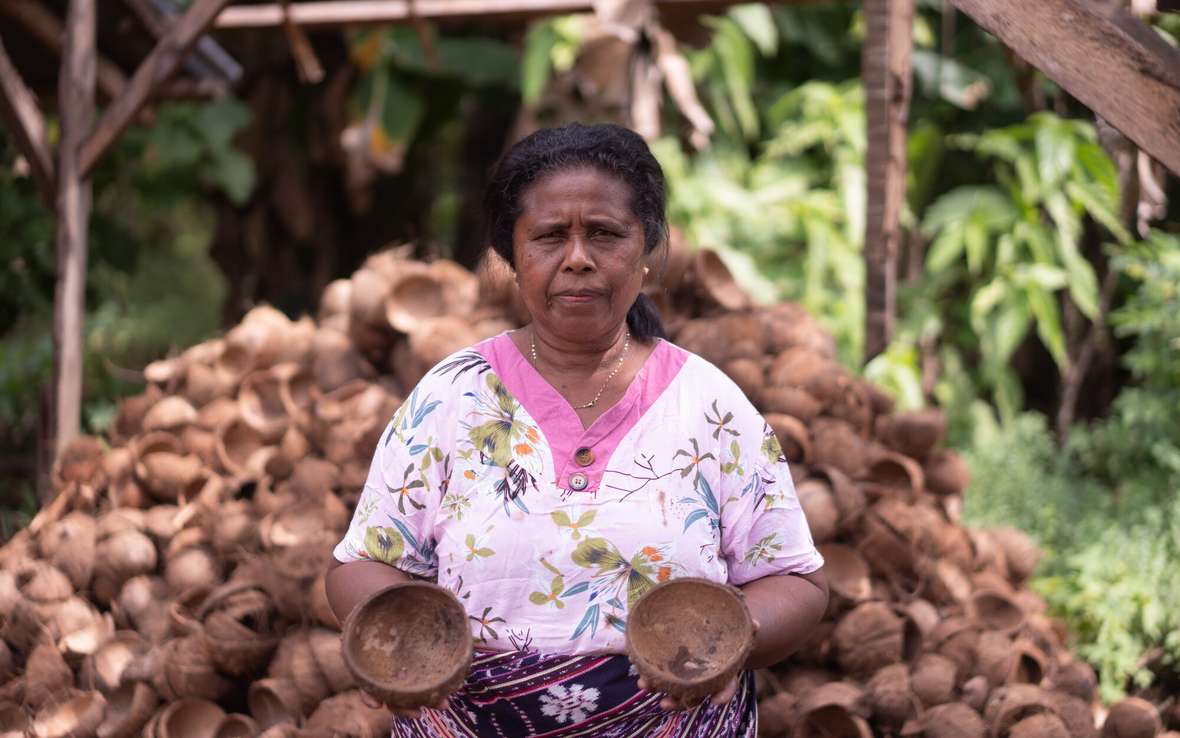
Villagers in Indonesia learn how to transform coconuts into sustainable products and sources of renewable energy.
How many products can you get out of one coconut? That’s a challenge YPPS, Oxfam’s partner in East Flores, Indonesia, is tackling through its Sekolah Kelapa (coconut schools) program. The schools aim to help people rediscover the uses of coconut, which has declined in yield and value, and also provide sustainable products, as the climate for farming in East Flores is harsh.
“Where we work, the impacts of climate change are being felt more strongly,” said Magdalena Rianghepat, project manager at YPPS. “What was already a dry climate has become even drier. Most people in East Flores are farmers, and now they are facing serious problems. Their production isn’t optimal. They plant seeds, but the seedlings never grow.”
A VISION FOR A VIBRANT ECO-COMMUNITY
YPPS‘s vision is that East Flores and its surrounding islands will one day be an eco-community. The aim of the Sekolah Kelapa is to offer collaborative learning spaces, and there are nine such spaces across six communities. Staff have been educating villagers about renewable energy, training farmers to use solar-powered drying houses to make copra (dried coconut meat), and teaching participants how to turn leftover coconut shells into high-quality, export-grade charcoal briquettes.
Copra is the main resource that can be produced from a coconut. It can be used to make coconut oil, but it has a variety of other uses. Traditionally, copra is either dried in the sun, which leaves it vulnerable to the elements and hungry animals, or by using smoke, which is harmful to health.
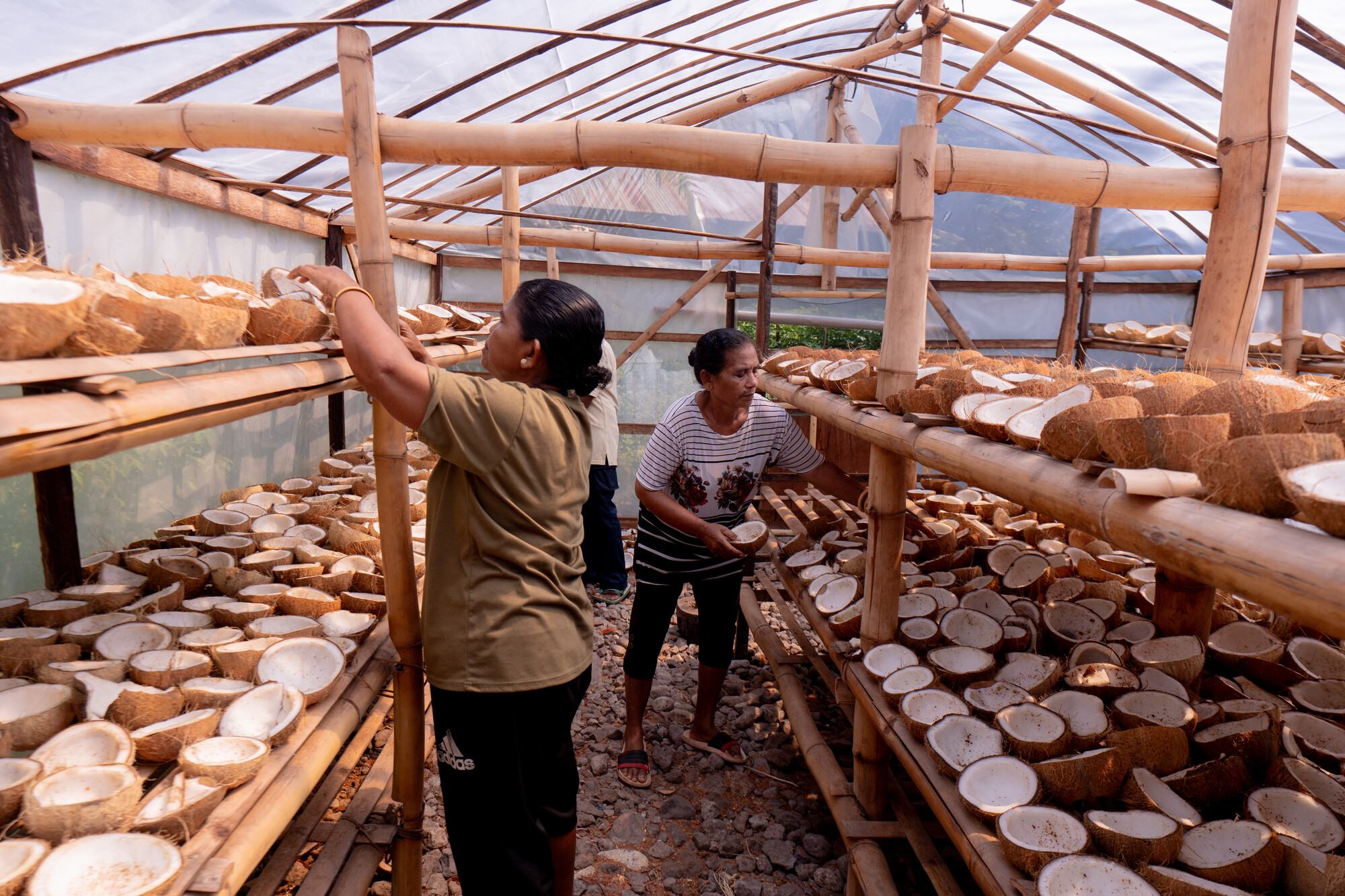
The solar dryers are proving to be a hit. “Before, drying took a full week,” said Mama Dalu, a farmer in a copra production group that received training from YPPS. “With this solar dryer house, it only takes four days.” When it rains, it can take up to two weeks for the copra to dry.
While drying the copra outside, women would have to keep watch to ensure animals didn’t interfere with the process. Mama Len, a village staff member with YPPS, reports, “Now, I don’t guard anymore …. We can work on other things at home. We can do laundry, go to the farm, or attend to other chores at home.”
HOW OXFAM PARTNERS ARE DRIVING CHANGE
Mama Len noted that in the past, once the copra was completed, people would throw away the coconut’s leftover parts. Through YPPS’s training, participants have learned to make briquettes by mixing charcoal powder from the husks with starch and then molding, pressing, and drying them. While these briquettes are an innovation and still being improved, they are delivering results.
During the dry season, people use wood for fuel, which requires searching for dry wood. In the wet season, people turn to gasoline. The briquettes are reducing the need to hunt for dry wood and helping to offset fuel costs.
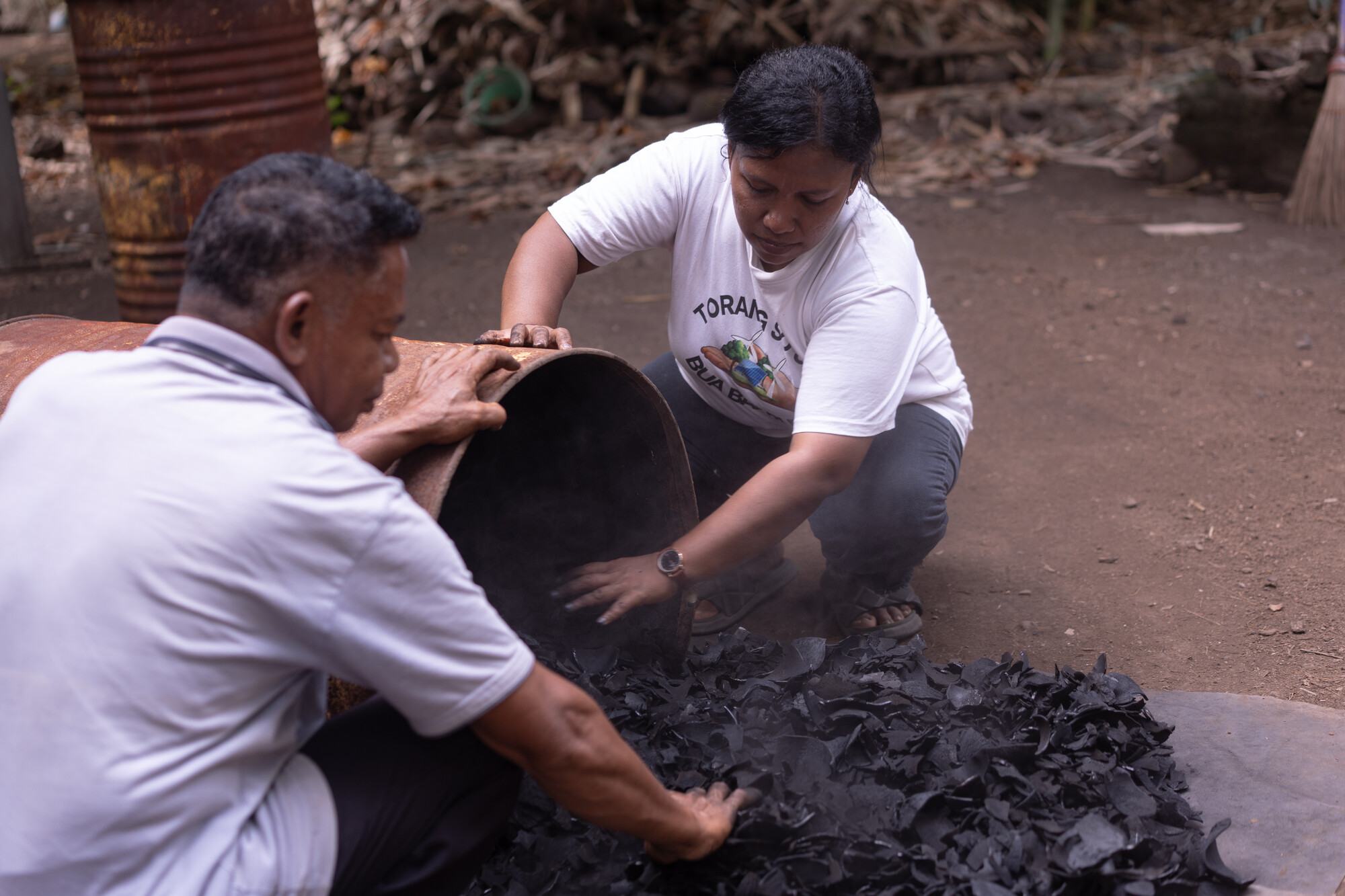
Farmer Pankrasius K. Liwun said that using the husks for charcoal has had a “clear economic impact” on his family’s life. Not only has using the briquettes reduced their reliance on gasoline, but they have also sold more than a ton of briquettes for profit. “In the past, we just burned the husks for nothing,” he said. “Now, nothing is wasted.”
BUILDING ECONOMIC SECURITY WITHOUT WASTE
Liwun said that with the current price, one person can earn Rp 750,000–800,00—around $45—a week making the briquettes.
No part of the fruit goes to waste. YPPS has also trained participants to turn coconut fibers into organic fertilizer.
More than 30 tons of coconut products have been processed and sold, generating hundreds of millions of rupiah. The charcoal briquettes are starting to be used by small businesses, such as grilled fish vendors.
These changes may seem small in the face of the massive impacts of climate change, but they are early steps toward creating an alternative system of energy. “What we’re aiming for is not simply copra production, or money,” said Program Manager Rianghepat. “It’s about reducing the usage of nonrenewable energy.”
Oxfam acknowledges the support of the Australian government through the Australian NGO Cooperation Program