New Oxfam America brief shows how raising taxes on New York's ultra-rich could ease the harmful effects of President Trump’s One Big Beautiful Bill Act.
As New York policymakers consider a range of proposed tax reforms, Oxfam America, part of the global organization fighting inequality to end poverty and injustice, released a new brief today detailing how a modest increase in taxes for New York’s wealthiest residents could raise revenue and restore tax fairness. According to Oxfam America, such proposals could help offset the One Big Beautiful Bill Act’s (OBBBA) inequality-fueling tax handouts to ultra-rich individuals, and fund investments to support people harmed by federal cuts.
New York’s billionaires — among the largest beneficiaries of the OBBBA’s tax handouts — have done exceptionally well in the past year:
- The wealth of the 10 richest New York billionaires — 9 of whom live in New York City — increased by $42.4 billion between March 2025 and March 2026, according to Forbes data.
- The 10 richest New York billionaires made an average of $4.2 billion each over that 12-month period, equivalent to a wage of $2 million an hour. It would take 82,863 years for the typical New York worker to make that much.
- The collective net worth of the 10 wealthiest New Yorkers now stands at $421.6 billion, equivalent to 18.2% of the state’s gross domestic product.
At the same time, New Yorkers are struggling with stagnant wages and rising costs for essentials like food and housing. New York has the ninth highest poverty rate out of all 50 states, and around half of New York rental households are “cost burdened,” spending 30% or more of their income on rent and utilities. Progressive taxation can help ensure that working- and middle-class families can afford to live in New York.
“In New York, where inequality is stark and public services are stretched thin, taxing the ultra-rich is not just a matter of fairness — it’s a necessity. There’s growing momentum behind such reforms because they’re a sensible way to reduce high levels of inequality and provide for ordinary people.” said Gabriel Zucman, economist and Director of the International Tax Observatory.
Oxfam America’s brief shows New York can increase taxes on rich individuals without triggering significant capital flight — a risk which is often greatly exaggerated. Evidence from U.S. states shows the risk of capital flight is negligible. In New Jersey, income tax increases had almost no impact on wealthy taxpayers leaving the state, but they raised critical revenue and lowered inequality. Massachusetts imposed a 4% surtax on incomes above $1 million in 2022, and the state’s number of millionaire residents actually increased in the two following years.
“Any time policymakers get serious about taxing the rich, it doesn’t take long for the empty threats about capital flight to follow. But evidence shows these concerns have no real basis — modest tax increases on the incomes of the wealthy lead to more state revenue, not less. Arguments to the contrary are little more than fearmongering by self-interested parties,” said Nabil Ahmed, senior director of economic justice at Oxfam America.
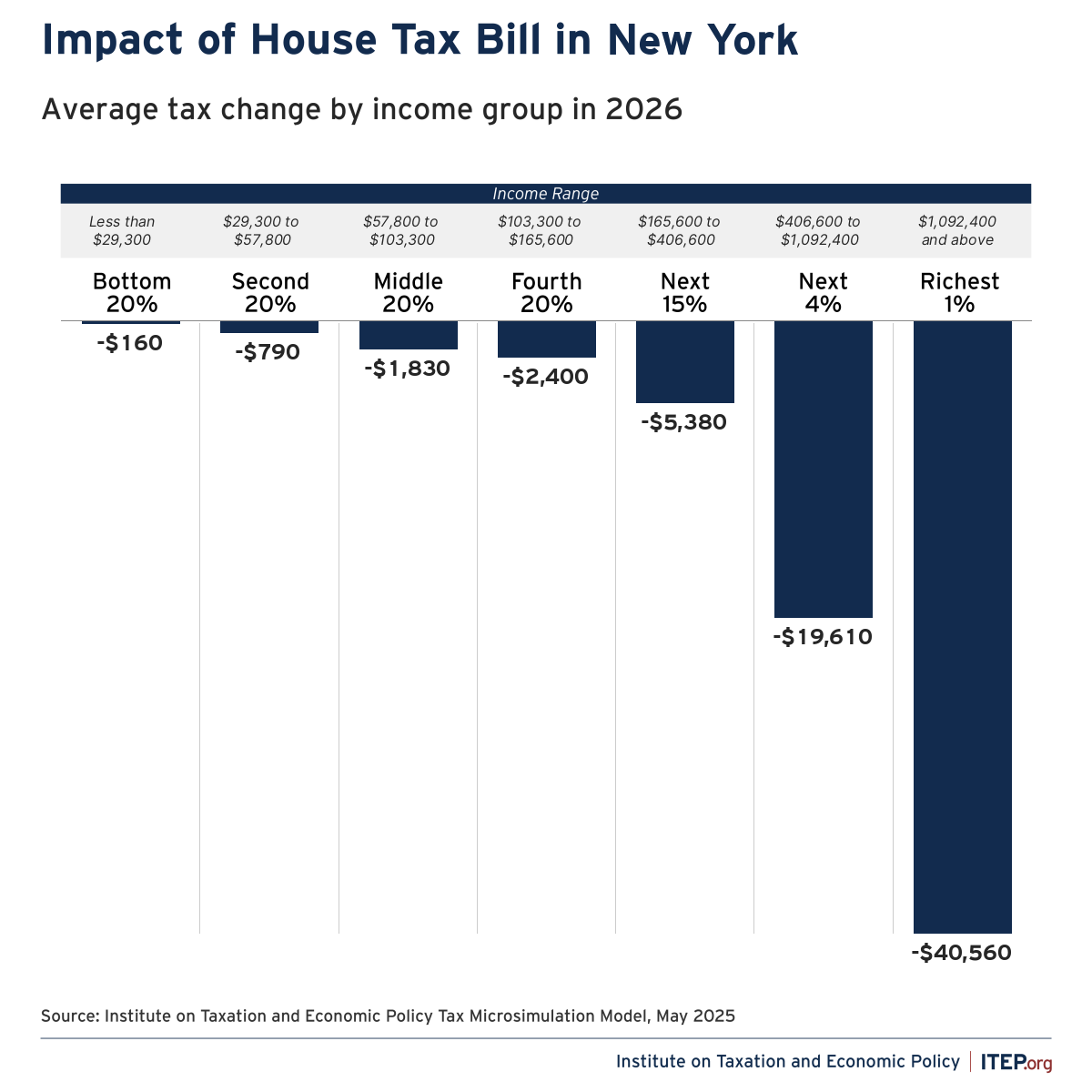
Meanwhile, the OBBBA just provided a massive windfall to wealthy New Yorkers. An analysis by the Institute on Taxation and Economic Policy (ITEP) found that in New York, the OBBBA gave the top 1% of earners (those with incomes at or over $1,092,400) an average tax break of $51,630 in 2026.
In comparison, changes to the federal tax code have made many working- and middle-class New York families worse off. Taken together, ITEP found that President’s Trump’s tax policies (defined as the OBBBA, tariffs, and the expiration of healthcare tax credits) only benefited the top 1% of earners in the state. All other income groups saw their taxes increase, with those in the bottom 20% (incomes between $0 and $29,300) seeing the largest hike. Safety net cuts included in the OBBBA could lead to as many as 1.5 million New Yorkers losing health coverage, and at least 300,000 New Yorkers losing food assistance.
Oxfam America argues states can help ease some of the worst effects of President Trump’s tax policies through progressive taxation. By taxing the ultra-rich, New York can make up some of the revenue lost by the OBBBA’s regressive tax breaks and invest in programs that help make the state more affordable for everyone.
Oxfam is a global organization that fights inequality to end poverty and injustice. We offer lifesaving support in times of crisis and advocate for economic justice, gender equality, and climate action. We demand equal rights and equal treatment so that everyone can thrive, not just survive. The future is equal. Join us at oxfamamerica.org.
/ENDS
Notes to editors:
Download Oxfam America’s brief, “The case for fairly taxing the rich in New York,” here.
Data on individual wealth of New York billionaires comes from Forbes Media, LCC. Figures compare wealth on March 7, 2025 with wealth on March 1, 2026.
ITEP’s analysis of the OBBBA’s impact in New York can be found here. Their analysis of the OBBBA combined with the effects of tariffs and the expiration of healthcare tax credits can be found here.